


U.S. orders $690M in swine-flu vaccine
The federal government is committing more than $800 million to buy more of the two key ingredients to make the H1N1 swine flu vaccine, according to the Department of Health and Human Services.
The money will be used to place additional orders on existing contracts with vaccine manufacturers including GlaxoSmithKline and Novartis. The former Chiron Corp. facility in Emeryville is now owned by Novartis, which makes vaccines there.
The government is placing orders for antigen and adjuvant. Antigen is the active ingredient in a vaccine that triggers the immune system to develop antibodies to fight the H1N1 virus. Adjuvant is added to boost the immune system and reduce the amount of antigen needed for the vaccine. The vaccine ingredients will become a part of the pandemic stockpile, for use if a vaccination campaign is necessary.
Frank VinluanSan Francisco Business Times
Read entire article
Attacks on U.S., Korea sites came from U.K.
The denial-of-service attacks launched on Web sites in South Korea and the United States earlier this month appear to have come from a master server in the United Kingdom, according to security researchers in Vietnam.
The master server controls all of the eight command and control servers involved in the series of distributed denial-of-service attacks that started on the July 4 weekend, security firm Bkis said in a blog posting on its Web site on Monday. Bkis said it gained control of two of the servers.
The Vietnamese firm estimated the number of compromised PCs involved in the attacks to be around 167,000 in 74 countries.
Botnet expert Joe Stewart of SecureWorks told CNET News that that number sounded high. Security experts had been estimating that there were 50,000 infected PCs in the botnet.
The attacks targeted dozens of government and commercial sites in the U.S. and South Korea, causing temporary outages at many of them.
Code on the compromised PCs was set to erase or overwrite data late last week but researchers in the U.S. were not aware of any reports of that happening.
Cnet
NSA’s cyber overkill
Cyber security is a real issue, as evidenced by the virus behind July 4 cyber attacks that hobbled government and business websites in the United States and South Korea. It originated from Internet provider addresses in 16 countries and targeted, among others, the White House and the New York Stock Exchange.
Unfortunately, the Obama administration has chosen to combat it in a move that runs counter to its pledge to be transparent. The administration reportedly is proceeding with a Bush-era plan to use the National Security Agency to screen government computer traffic on private-sector networks. AT&T is slated to be the likely test site. This classified pilot program, dubbed "Einstein 3," is developed but not yet rolled out. It takes two offenders from President Bush's contentious secret surveillance program and puts them in charge of scrutinizing all Internet traffic going to or from federal government agencies.
Einstein 3 purportedly is meant to protect government networks from hackers. But cyber-security experts -- such as Babak Pasdar, who blew the whistle on a mysterious "Quantico Circuit" while working for a major service provider -- agree that Einstein 3 offers no intrinsic security value. The program is implemented where servers exchange traffic between one another -- in the heart of a network system rather than at the perimeter, which interfaces with the outside world. This is similar to a home security system that only monitors the central interior of a house, rather than keeping an eye on the actual doors (and the purpose of hackers may simply be to enter).
Furthermore, Einstein 3 focuses on collecting, processing and analyzing all person-to-person communications content rather than looking for hacker and malicious software attack patterns directed at government sites and installations -- which should raise eyebrows.
Jesselyn Radack
Lost Angeles Times
Read Entire Article
US launches review of terror warning system
WASHINGTON (AFP) — The United States on Tuesday announced a review of its often-criticized terror alert system created in the wake of the September 11, 2001 attacks.
The system includes a color-coded public warnings, which range from green, symbolizing a low risk of attack to red, which points to a severe threat.
Homeland Security Secretary Janet Napolitano said in a statement a bipartisan panel of experts would report on the efficiency of the system within 60 days.
"My goal is simple: to have the most effective system in place to inform the American people about threats to our country," Napolitano said in a statement.
The secretary -- who heads a department also created after the attacks -- said she had appointed a senior George W. Bush security adviser Fran Townsend to lead the panel.
Critics say such threat coding is too vague and provide little or no actionable information for travelers, while causing alarm.
In 2003, a congressional report warned that levels were so vague that they would lead the public to question their usefulness.
But scrapping the system is likely to provide fodder for President Barack Obama's critics, who accuse him rolling back anti-terror polices to the detriment of national security.
Former vice president Dick Cheney has frequently spared with the Obama since leaving office, accusing him of making the country more vulnerable to attack.
The current threat level is yellow, "a significant risk of terrorist attacks," where it has stood since since 2004, although specific sector or route advisories have changed.
In August 2006, the threat level was raised from orange to red for flights to the United States from Britain, after authorities in London unraveled a plot to blow up as many as 10 trans-Atlantic airliners.
The threat level is published on the Department of Homeland Security's website and features in public service announcements in US airports.
Britain has a similar system, operated by the internal security service commonly known as MI5.
source
Snooping through the power socket
Power sockets can be used to eavesdrop on what people type on a computer.
Security researchers found that poor shielding on some keyboard cables means useful data can be leaked about each character typed.
By analysing the information leaking onto power circuits, the researchers could see what a target was typing.
The attack has been demonstrated to work at a distance of up to 15m, but refinement may mean it could work over much longer distances.
Hotel attack
"Our goal is to show that information leaks in the most unexpected ways and can be retrieved," wrote Andrea Barisani and Daniele Bianco, of security firm Inverse Path, in a paper describing their work.
The research focused on the cables used to connect PS/2 keyboards to desktop PCs.
Usefully, said the pair, the six wires inside a PS/2 cable are typically "close to each other and poorly shielded". This means that information travelling along the data wire, when a key is pressed, leaks onto the earth (ground in the US) wire in the same cable.
The earth wire, via the PC's power unit, ultimately connects to the plug in the power socket, and from there information leaks out onto the circuit supplying electricity to a room.
Even better, said the researchers, data travels along PS/2 cables one bit at a time and uses a clock speed far lower than any other PC component. Both these qualities make it easy to pick out voltage changes caused by key presses.
A digital oscilloscope was used to gather data about voltage changes on a power line and filters were used to remove those caused by anything other than the keyboard.
"The PS/2 signal square wave is preserved with good quality... and can be decoded back to the original keystroke information," wrote the pair in a paper describing their work.
They demonstrated it working over distances of 1, 5, 10 and 15m from a target, far enough to suggest it could work in a hotel or office.
"The test performed in the laboratory represent a worst case scenario for this type of measurement, which along with acceptable results emphasizes the feasibility of the attack on normal conditions," they added.
The pair said their research was "work in progress" and expect the equipment to get more sensitive as it is refined.
The attack is due to be demonstrated at the Black Hat conference that takes place in Las Vegas from 25-30 July.
BBC

China may attack India by 2012
A leading defence expert has projected that China will attack India by 2012 to divert the attention of its own people from “unprecedented” internal dissent, growing unemployment and financial problems that are threatening the hold of Communists in that country.
“China will launch an attack on India before 2012. There are multiple reasons for a desperate Beijing to teach India the final lesson, thereby ensuring Chinese supremacy in Asia in this century,” Bharat Verma, Editor of the Indian Defence Review, has said.
Verma said the recession has “shut the Chinese exports shop”, creating an “unprecedented internal social unrest” which in turn, was severely threatening the grip of the Communists over the society.
Among other reasons for this assessment were rising unemployment, flight of capital worth billions of dollars, depletion of its foreign exchange reserves and growing internal dissent, Verma said in an editorial in the forthcoming issue of the premier defence journal. In addition to this, “The growing irrelevance of Pakistan, their right hand that operates against India on their behest, is increasing the Chinese nervousness,” he said, adding that US President Barak Obama’s Af-Pak policy was primarily Pak-Af policy that has “intelligently set the thief to catch the thief”.
Verma said Beijing was “already rattled, with its proxy Pakistan now literally embroiled in a civil war, losing its sheen against India.” “Above all, it is worried over the growing alliance of India with the US and the West, because the alliance has the potential to create a technologically superior counterpoise.
“All these three concerns of Chinese Communists are best addressed by waging a war against pacifist India to achieve multiple strategic objectives,” he said.
While China “covertly allowed” North Korea to test underground nuclear explosion and carry out missile trials, it was also “increasing its naval presence in South China Sea to coerce into submission those opposing its claim on the Sprately Islands,” the defence expert said. He said it would be “unwise” at this point of time for a recession-hit China to move against the Western interests, including Japan.
“Therefore, the most attractive option is to attack a soft target like India and forcibly occupy its territory in the Northeast,” Verma said. But India is “least prepared” on ground to face the Chinese threat, he says and asks a series of questions on how will India respond to repulse the Chinese game plan or whether Indian leadership would be able to “take the heat of war”.
“Is Indian military equipped to face the two-front wars by Beijing and Islamabad? Is the Indian civil administration geared to meet the internal security challenges that the external actors will sponsor simultaneously through their doctrine of unrestricted warfare? “The answers are an unequivocal ‘no’. Pacifist India is not ready by a long shot either on the internal or the external front,” the defence journal editor says. In view of the “imminent threat” posed by China, “the quickest way to swing out of pacifism to a state of assertion is by injecting military thinking in the civil administration to build the sinews. That will enormously increase the deliverables on ground – from Lalgarh to Tawang,” he says.
SPLC’s Dees: Army Training White Supremacists
A white supremacist's recent shooting attack at the US Holocaust Memorial Museum was part of a surge in extremist activity nationwide, according to Morris Dees
White supremacist groups are increasingly relying on US military training, Dees, co-founder of the Southern Poverty Law Center, which works to track and shut down hate groups across America, said on Friday.
Speaking at a luncheon at the National Press Club, he discussed the findings of a report the Law Center released that day.
"Large numbers of potentially violent neo-Nazi skinheads and others are now learning the art of warfare in the United States military," Dees said.
Along with the report, the Law Center sent Congress a letter urging the investigation of how racist organizations are "infiltrating" the military.
Dees identified two ways in which hate groups take advantage of military training. Some extremists enter the armed forces to learn skills they will later take back to their groups, while in other instances, these groups work to recruit frustrated veterans.
Beyond the military, Dees said his organization sees a rise in hate groups, and it now lists more than 900.
"Hate groups are on the rise in the United States," he said. "The 'perfect storm' is brewing for the buildup of these hate groups."
Anger over the election of a black president, the failing economy and Latino immigration are all causing this phenomenon, he explained. He added that at the heart of most of these hate groups is a simple belief that "Jews are the enemy."
For instance, James von Brunn, who shot security guard Stephen Johns at the Holocaust Museum, blamed the Jews for the decline of the white race and had written that "Obama was created by the Jews. Obama does what his Jew owners say."
Sam Greenberg
Jerusalem Post
Read Entire Article
Iran not a Twitter Revolution
Just days after his return from post-election Iran, we spoke with journalist and author Reece Erlich. Erlich explains that the importance placed on Internet social networking like Twitter by the Western media is a function of how they have been learning about the events, not a reflection on the movement as a whole. “The movement is a lot broader than the relatively well-to-do people who can afford to send Twitter or invest in computer equipment,” says Erlich. Erlich published a book in 2007 exposing US attempts to destabilize Iran, such as the funding of domestic terrorist groups. But he adds that while the CIA and others may be active in the country, they are not responsible for the uprising.
RealNewsNetwork
All Britons to be vaccinated against A/H1N1 flu
All Britons could be vaccinated against the A/H1N1 flu as the number of confirmed cases in Britain is moving closer toward 10,000, health authorities said Sunday.
The first doses of A/H1N1 vaccine are set to arrive in Britain in September and could be fast-tracked through regulatory approval in less than a week.
Health officials have put forward plans to build a nationwide immunity to the disease, the biggest vaccination program of the past 50 years.
Health experts have already provided a priority list of patients, and the fast-tracking system has been established since the first British patient without underlying health problems died of the disease.
Lead negotiator on A/H1N1 of the British Medical Association Peter Holden told the Sunday Times the high risk groups will be done at the local clinics.
He added that if the virus does mutate, the idea is to give people immunity, but he also admitted that the sheer logistics of dealing with 60 million people can’t be underestimated.
It is reported on Friday that a patient at an Essex hospital has become the first person in Britain without underlying health problems to die of the infection, bringing the death toll in the country to 15.
It is expected to surge in the winter months when flu is more prevalent.
There are 9,718 confirmed cases of A/H1N1 in Britain, according to the latest figures from the Health Protection Agency.
Rockefeller Foundation: Climate change ‘will cause civilization to collapse’
An effort on the scale of the Apollo mission that sent men to the Moon is needed if humanity is to have a fighting chance of surviving the ravages of climate change. The stakes are high, as, without sustainable growth, “billions of people will be condemned to poverty and much of civilisation will collapse”.
This is the stark warning from the biggest single report to look at the future of the planet – obtained by The Independent on Sunday ahead of its official publication next month. Backed by a diverse range of leading organisations such as Unesco, the World Bank, the US army and the Rockefeller Foundation, the 2009 State of the Future report runs to 6,700 pages and draws on contributions from 2,700 experts around the globe. Its findings are described by Ban Ki-moon, Secretary-General of the UN, as providing “invaluable insights into the future for the United Nations, its member states, and civil society”.
The impact of the global recession is a key theme, with researchers warning that global clean energy, food availability, poverty and the growth of democracy around the world are at “risk of getting worse due to the recession”. The report adds: “Too many greedy and deceitful decisions led to a world recession and demonstrated the international interdependence of economics and ethics.”
Although the future has been looking better for most of the world over the past 20 years, the global recession has lowered the State of the Future Index for the next 10 years. Half the world could face violence and unrest due to severe unemployment combined with scarce water, food and energy supplies and the cumulative effects of climate change.
And the authors of the report, produced by the Millennium Project – a think-tank formerly part of the World Federation of the United Nations Associations – set out a number of emerging environmental security issues. "The scope and scale of the future effects of climate change – ranging from changes in weather patterns to loss of livelihoods and disappearing states – has unprecedented implications for political and social stability."
The Independent
Jonathan Owen
Read Entire Article
Egypt Calls for Establishing New World Order to Overcome Crises
Egyptian Assistant Foreign Minister Naela Gabr said Saturday that the world society should make joint efforts to set up a new world order to deal with various crises.
Gabr made the appeal when addressing the senior officials’ meeting of the 15th Non-Aligned Movement (NAM) summit, which opened Saturday in Egyptian Red Sea resort of Sharm el-Sheikh.
The current world situation is quite different from 48 years ago when the NAM was founded, with increasing population, outbreaks of epidemic and deteriorating environment, she said.
The world society should reconsider the international financial system and be more democratic in decision-making so as to avoid the global financial crisis which has hampered the economic growth of developing countries, Gabr said.
She also called for restructuring of international mechanism in health and agriculture in an effort to help overcome the crises in the two areas, referring to global spread of A/H1N1 flu and rising food prices.
Senior officials from over 140 countries gathered here to work out basic documents for the coming NAM summit, which will state the movement’s stance in the current international context on major international and regional issues like the global financial crisis, the Middle East peace process, and the Iranian nuclear issue.
The NAM has played a significant role in protecting rights and interests of its member states, and Egypt, as it will be the rotating chair of the group of pan-developing countries, will endeavor to strengthen its role in the world arena, she added.
Formally founded in September 1961, NAM groups 118 member states, which represents nearly two-thirds of the United Nations’ members, particularly developing countries. It also comprises 55 percent of the world population.
Crienglish
Brüno's Ron Paul Set-up
What was the point of setting up Ron Paul? He is the only the true alternative to all the fake politicians, was this a hit piece?
Watch these videos before youpoop pull's them off ...
DARPA plans to end swine flu using Triffid drugs
Crazed US military boffins, their plans for the eradication of humanity in a machine-rebellion bloodbath at a stand, have adopted an alternative strategy. They plan now to develop a “plant-based production system”, ostensibly for the harvest of valuable products beneficial to humanity – but which seems certain to unleash a terrifying unforeseen Triffid-like vegetable horror upon suffering humanity.
The crazed boffins in question, it seems needless to say, are those of DARPA, the famous Defence Advanced Research Projects Agency. It’s important to remember that very few of DARPA’s ambitious plans – which often involve a significant risk of wiping out the human race – ever come to anything. But they only have to be (un)lucky once.
In this case, the federal warboffins appear to be motivated by the ongoing swine flu outbreak. They say (Word doc):
The 2009 H1N1 swine flu pandemic has highlighted the national need for larger scale vaccine manufacturing capabilities … Recent advances funded by DARPA and others have demonstrated the viability of plant-based protein expression technologies for the production and purification of cGMP-compliant medical countermeasures …Requested are approaches that demonstrate a proof-of-concept facility capable of growing adequate plant biomass for the production of protein … Emphasis should be placed on infrastructure requirements and design, as well as equipment needed for the growth, processing, purification and validation of products …
It won’t have escaped readers of John Wyndham’s dystopian classic The Day of the Triffids that there are some parallels here. The eponymous shuffling vegetable assassins of the book were theorised to have arisen as “the outcome of a series of ingenious biological meddlings – and very likely accidental, at that”, most probably by secret government labs in Russia. In the book, large-scale cultivation and processing of Triffids began because “the extracts they give were very valuable in the circumstances”.
Just as rapidly-produced vaccines could be in an age of global pandemics, in fact. Open and shut case.

Lewis Page
The Register
Read Entire Article
The next hacking frontier: Your brain?
Hackers who commandeer your computer are bad enough. Now scientists worry that someday, they'll try to take over your brain.
the past year, researchers have developed technology that makes it possible to use thoughts to operate a computer, maneuver a wheelchair or even use Twitter -- all without lifting a finger. But as neural devices become more complicated, and go wireless, some scientists say the risks of "brain hacking" should be taken seriously.
"Neural devices are innovating at an extremely rapid rate and hold tremendous promise for the future," said computer security expert Tadayoshi Kohno of the University of Washington.
"But if we don't start paying attention to security, we're worried that we might find ourselves in five or 10 years saying we've made a big mistake."
Hackers tap into personal computers all the time. But what would happen if they focused their nefarious energy on neural devices, such as the deep-brain stimulators used to treat Parkinson's and depression, or electrode systems for controlling prosthetic limbs?
According to Kohno and his colleagues, who published their concerns July 1 in Neurosurgical Focus, most devices carry few security risks. But as neural engineering becomes more complex and more widespread, the potential for security breaches will mushroom.
"It's very hard to design complex systems that don't have bugs," Kohno said. "As these medical devices start to become more and more complicated, it gets easier and easier for people to overlook a bug that could become a very serious risk. It might border on science fiction today, but so did going to the moon 50 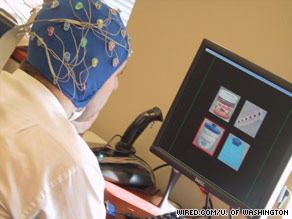
Some might question why anyone would want to hack into someone else's brain, but the researchers say there's a precedent for using computers to cause neurological harm. In November 2007 and March 2008, malicious programmers vandalized epilepsy support Web sites by putting up flashing animations, which caused seizures in some photo-sensitive patients.
"It happened on two separate occasions," said computer science graduate student Tamara Denning, a co-author on the paper. "It's evidence that people will be malicious and try to compromise peoples' health using computers, especially if neural devices become more widespread."
In some cases, patients might even want to hack into their own neural device. Unlike devices to control prosthetic limbs, which still use wires, many deep brain stimulators already rely on wireless signals. Hacking into these devices could enable patients to "self-prescribe" elevated moods or pain relief by increasing the activity of the brain's reward centers.
Despite the risks, Kohno said, most new devices aren't created with security in mind. Neural engineers carefully consider the safety and reliability of new equipment, and neuroethicists focus on whether a new device fits ethical guidelines. But until now, few groups have considered how neural devices might be hijacked to perform unintended actions. This is the first time an academic paper has addressed the topic of "neurosecurity," a term the group coined to describe their field.
Wired
Read Entire Article
Greening the Internet: How much CO2 does this article produce?
Twenty milligrams; that's the average amount of carbon emissions generated from the time it took you to read the first two words of this article.
Now, depending on how quickly you read, around 80, perhaps even 100 milligrams of C02 have been released. And in the several minutes it will take you to get to the end of this story, the number of milligrams of greenhouse gas emitted could be several thousand, if not more.
This may not seem like a lot: "But in aggregate, if you consider all the people visiting a web site and then all the seconds that each of them spends on it, it turns out to be a large number," says Dr. Alexander Wissner-Gross, an Environmental Fellow at Harvard University who studies the environmental impact of computing.
Wissner-Gross estimates every second someone spends browsing a simple web site generates roughly 20 milligrams of C02. Whether downloading a song, sending an email or streaming a video, almost every single activity that takes place in the virtual environment has an impact on the real one.
As millions more go online each year some researchers say the need to create a green Internet ecosystem is not only imperative but also urgent.
"It is part of the whole sustainability picture," Chris Large, head of research and development at UK-based Climate Action Group, told CNN.
"Scientists are saying to us that we have 10 years to take some serious action to avoid the most catastrophic effects of climate change so taking some sort of initiative is absolutely vital."
A number of studies have highlighted the growing energy demands of computers. A 2007 report from research firm Gartner, for example, estimates the manufacturing, use and disposal of information and communications technology generates about two percent of the world's greenhouse gases -- similar to the level produced by the entire aviation industry.
Anti-virus software firm McAfee reports that the electricity needed just to transmit the trillions of spam emails sent annually equals the amount required to power over two million homes in the United States while producing the same level of greenhouse gas emissions as more than three million cars.
"Most people don't appreciate that the computer on your desk is contributing to global warming and that if its electricity comes from a coal power plant it produces as much C02 as a sports utility vehicle," said Bill St. Arnaud of Canarie, a Canada-based internet development organization.
"Some studies estimate the internet will be producing 20 percent of the world's greenhouse gases in a decade. That is clearly the wrong direction. That is clearly unsustainable," added St. Arnaud.
What do you include when working out IT's carbon footprint?
Calculating the carbon footprint of the entire web however is not as easy as measuring the greenhouse gas emissions of a car.
Data centers -- massive buildings housing hundreds, if not thousands, of power hungry servers storing everything from Facebook photos and YouTube videos to company web sites and personal emails -- are often labeled as the worst offenders when it comes to harming the environment.
In 2002, global data center emissions amounted to 76 million tons of carbon dioxide -- a figure that is likely to more than triple over the next decade, according to a 2008 study by the Climate Group and Global e-Sustainability Initiative (GeSI).
Lara Farrar
CNN
Read Entire Article
Obama's Tough Love for Africa
President Obama reached out to Africa on Saturday with a wide-ranging address praising the continent's steady achievements, but he called its persistent violent conflicts "a millstone around Africa's neck."
"Despite the progress that has been made -- and there has been considerable progress in parts of Africa -- we also know that much of that promise has yet to be fulfilled," Obama said in a speech to the parliament of Ghana, a western African nation seen as a model of democracy and growth for the rest of the continent.
Ghana was the first sub-Saharan nation to gain independence, in 1957, and Obama continually cited the nation during his speech for its stability, political strides and painstaking economic progress. Its stability stands in contrast to other hot spots on the continent, such as Zimbabwe, where the society is in economic and political turmoil; Sudan, where fighting rages in the Darfur region; and Somalia, where a shaky transitional government is now battling an Islamic insurgency.
Ghana, with a population of 24 million, was once a major slave trading center. Obama visited the Cape Coast Castle, a British outpost where slaves were held until shipped overseas, along with his daughters. 
"I think it was particularly important for Malia and Sasha, who are being raised in a very blessed way, that history can take some cruel turns," he said. "And hopefully, one of the things that was imparted to them during this trip is their sense of obligation to fight oppression and cruelty wherever it appears."
Obama, whose father was Kenyan, compared the history to that of the Holocaust, Nazi Germany's efforts to exterminate the Jews of Europe during World War II.
"It's one of those things that you don't forget about," he told CNN in an interview scheduled to air Monday on "Anderson Cooper 360."
"I think it's important that the way we think about it, the way it's taught, is not one in which there's simply a victim and a victimizer, and that's the end of the story," he said. "I think the way it has to be thought about, the reason it's relevant, is whether it's what's happening in Darfur or what's happening in the Congo or what's happening in too many places around the world, the capacity for cruelty still exists."
But he told lawmakers that Ghana now shows "a face of Africa that is too often overlooked by a world that sees only tragedy or the need for charity." While the nation-building the country exemplifies may lack "drama of the 20th century's liberation struggles," he said "it will ultimately be more significant."
As he has in past remarks, including his Cairo address last month about U.S.-Muslim relations, Obama stressed the superiority of governments that "respect the will of their own people," saying they foster more prosperity and stability than governments that don't.
"No business wants to invest in a place where the government skims 20 percent off the top, or the head of the Port Authority is corrupt," he said. "No person wants to live in a society where the rule of law gives way to the rule of brutality and bribery. That is not democracy, that is tyranny, even if occasionally you sprinkle an election in there."
Even Kenya, his father's homeland, continues to struggle with tribalism and corruption, he said. That eastern African nation "had a per-capita economy larger than South Korea's when I was born" and now, he says, it has been "badly outpaced."
But he said Kenya has restored stability after the violence that followed the disputed 2007 election. South Africa has had high voter turnout in recent elections, and Zimbabwe's Election Support Network has defended the right to vote.
"Make no mistake: history is on the side of these brave Africans, and not with those who use coups or change constitutions to stay in power. Africa doesn't need strongmen, it needs strong institutions," he said. He said his administration will work "to support those who act responsibly and to isolate those who don't, and that is exactly what America will do."
As for the economy and opportunity, he said African nations need to stop focusing on one particular commodity, such as oil or cocoa, and "promote multiple export industries, develop a skilled work force, and create space for small and medium-sized businesses that create jobs."
He cited "our $3.5 billion food security initiative" and said "new methods and technologies for farmers -- not simply sending American producers or goods to Africa" is what is needed. 
Obama also made reference to climate and energy challenges, saying the developed world should work with Africa to confront such problems. He said Africa has much potential to exploit its wind and solar power and geothermal energy and biofuels.
s for disease, Obama said strides are being made in dealing with HIV/AIDS and malaria, but "too many still die from diseases that shouldn't kill them." He also indicated that there need to be ways to keep African doctors and nurses from going overseas and creating gaps in primary care."When children are being killed because of a mosquito bite, and mothers are dying in childbirth, then we know that more progress must be made."
He said his administration has committed $63 billion to fight disease, praising the "strong efforts" of his predecessor, George W. Bush.
Obama welcomed efforts by the African Union and the Economic Community of West African States to help resolve conflict. He said the United States "will stand behind efforts to hold war criminals accountable" and that the Pentagon's Africa Command will fight "common challenges to advance the security of America, Africa and the world."
"We all have many identities -- of tribe and ethnicity; of religion and nationality. But defining oneself in opposition to someone who belongs to a different tribe, or who worships a different prophet, has no place in the 21st century," he said.
"Africa's diversity should be a source of strength, not a cause for division. We are all God's children," he said.ACCRA, Ghana (CNN)
Report: Domestic surveillance program relied on flawed analysis
The highly controversial no-warrant surveillance program initiated after the September 11 terrorist attacks relied on a "factually flawed" legal analysis inappropriately provided by a single Justice Department official, according to a report to Congress on Friday.
The report was compiled by the inspectors general of the nation's top intelligence agencies, the Pentagon and the Justice Department.
The report, mandated by Congress, provides fresh context to information previously leaked in press accounts and buttressed by both congressional testimony and books written by former officials involved in the surveillance effort.
The 38-page unclassified version of the document reaches a cautious conclusion, stating that any use of the information collected under the surveillance program "should be carefully monitored."
The program, launched by President Bush in the weeks after the September 11 attacks, allowed for -- without court approval -- the interception of communications into and out of the United States if there was a "reasonable basis" that one of the parties was a terrorist.
The report, though not critical of the program's objectives, sharply criticizes the legal advice provided to the White House by the Justice Department.
Among other things, the report cites a Justice Department conclusion that "it was extraordinary and inappropriate that a single DOJ attorney, John Yoo, was relied upon to conduct the initial legal assessment" of the surveillance program.
"The lack of oversight and review of Yoo's work ... contributed to a legal analysis of the [program] that at a minimum was factually flawed," it says.
The report says Yoo largely circumvented both his boss, Assistant Attorney General Jay Bybee, and Attorney General John Ashcroft.
Yoo, described by Bybee in the report as "the White House's guy" on national security, also provided the legal justification for the CIA's controversial harsh interrogation program. Yoo's legal rationale was later repudiated by the Justice Department.
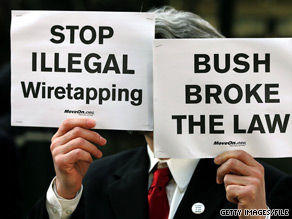
The bitter debate within the Justice Department over the legal basis for the warrantless surveillance and related intelligence efforts is highlighted in references to the much-documented dramatic account of a March 2004 confrontation in Ashcroft's hospital room. Deputy Attorney General James Comey defied then-White House Counsel Alberto Gonzales by refusing to sign off on the reauthorization of the program.
The report notes that several members of Congress -- including then-House Intelligence Committee Chairwoman Nancy Pelosi -- were briefed on the program on October 25, 2001, and a total of 17 times before the program became public in 2005.
The document repeats the public assertion by former National Security Agency Director Michael Hayden that no member of Congress had urged that the program be stopped.
The new report makes clear that the President's Surveillance Program was only a small part of the counterterrorism intelligence efforts in the aftermath of the September 11 attacks, and its impact even today remains unclear.
Most of the intelligence officials interviewed by the inspectors general had, according to the report, "difficulty citing specific instances where PSP reporting had directly contributed to counterterrorism successes."
The report was compiled by inspectors general of five agencies despite the apparent refusal by key figures -- including Yoo, former Attorney General John Ashcroft and former CIA Director George Tenet -- to be interviewed by investigators.
Those who consented to be interviewed by the investigators included Hayden, former Director of National Intelligence John Negroponte, former White House Counsel and Attorney General Gonzales, FBI Director Robert Mueller and former Secretary of Defense Donald Rumsfeld.Pam Benson and Terry Frieden
WASHINGTON (CNN)


