


Snooping through the power socket
Power sockets can be used to eavesdrop on what people type on a computer.
Security researchers found that poor shielding on some keyboard cables means useful data can be leaked about each character typed.
By analysing the information leaking onto power circuits, the researchers could see what a target was typing.
The attack has been demonstrated to work at a distance of up to 15m, but refinement may mean it could work over much longer distances.
Hotel attack
"Our goal is to show that information leaks in the most unexpected ways and can be retrieved," wrote Andrea Barisani and Daniele Bianco, of security firm Inverse Path, in a paper describing their work.
The research focused on the cables used to connect PS/2 keyboards to desktop PCs.
Usefully, said the pair, the six wires inside a PS/2 cable are typically "close to each other and poorly shielded". This means that information travelling along the data wire, when a key is pressed, leaks onto the earth (ground in the US) wire in the same cable.
The earth wire, via the PC's power unit, ultimately connects to the plug in the power socket, and from there information leaks out onto the circuit supplying electricity to a room.
Even better, said the researchers, data travels along PS/2 cables one bit at a time and uses a clock speed far lower than any other PC component. Both these qualities make it easy to pick out voltage changes caused by key presses.
A digital oscilloscope was used to gather data about voltage changes on a power line and filters were used to remove those caused by anything other than the keyboard.
"The PS/2 signal square wave is preserved with good quality... and can be decoded back to the original keystroke information," wrote the pair in a paper describing their work.
They demonstrated it working over distances of 1, 5, 10 and 15m from a target, far enough to suggest it could work in a hotel or office.
"The test performed in the laboratory represent a worst case scenario for this type of measurement, which along with acceptable results emphasizes the feasibility of the attack on normal conditions," they added.
The pair said their research was "work in progress" and expect the equipment to get more sensitive as it is refined.
The attack is due to be demonstrated at the Black Hat conference that takes place in Las Vegas from 25-30 July.
BBC

The next hacking frontier: Your brain?
Hackers who commandeer your computer are bad enough. Now scientists worry that someday, they'll try to take over your brain.
the past year, researchers have developed technology that makes it possible to use thoughts to operate a computer, maneuver a wheelchair or even use Twitter -- all without lifting a finger. But as neural devices become more complicated, and go wireless, some scientists say the risks of "brain hacking" should be taken seriously.
"Neural devices are innovating at an extremely rapid rate and hold tremendous promise for the future," said computer security expert Tadayoshi Kohno of the University of Washington.
"But if we don't start paying attention to security, we're worried that we might find ourselves in five or 10 years saying we've made a big mistake."
Hackers tap into personal computers all the time. But what would happen if they focused their nefarious energy on neural devices, such as the deep-brain stimulators used to treat Parkinson's and depression, or electrode systems for controlling prosthetic limbs?
According to Kohno and his colleagues, who published their concerns July 1 in Neurosurgical Focus, most devices carry few security risks. But as neural engineering becomes more complex and more widespread, the potential for security breaches will mushroom.
"It's very hard to design complex systems that don't have bugs," Kohno said. "As these medical devices start to become more and more complicated, it gets easier and easier for people to overlook a bug that could become a very serious risk. It might border on science fiction today, but so did going to the moon 50 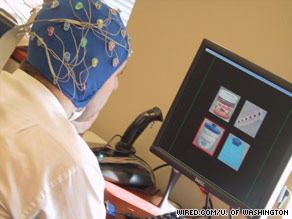
Some might question why anyone would want to hack into someone else's brain, but the researchers say there's a precedent for using computers to cause neurological harm. In November 2007 and March 2008, malicious programmers vandalized epilepsy support Web sites by putting up flashing animations, which caused seizures in some photo-sensitive patients.
"It happened on two separate occasions," said computer science graduate student Tamara Denning, a co-author on the paper. "It's evidence that people will be malicious and try to compromise peoples' health using computers, especially if neural devices become more widespread."
In some cases, patients might even want to hack into their own neural device. Unlike devices to control prosthetic limbs, which still use wires, many deep brain stimulators already rely on wireless signals. Hacking into these devices could enable patients to "self-prescribe" elevated moods or pain relief by increasing the activity of the brain's reward centers.
Despite the risks, Kohno said, most new devices aren't created with security in mind. Neural engineers carefully consider the safety and reliability of new equipment, and neuroethicists focus on whether a new device fits ethical guidelines. But until now, few groups have considered how neural devices might be hijacked to perform unintended actions. This is the first time an academic paper has addressed the topic of "neurosecurity," a term the group coined to describe their field.
Wired
Read Entire Article
NSA Security running amok to plug leaks about 9/11
WMR has learned that the National Security ‘Q’ Group, responsible for security, has grown to an immense security and counter-intelligence force, with an estimated one thousand government employees, contractors, and paid informants. NSA’s Security force is reportedly primarily tasked with plugging any leaks of classified or other information that points to U.S. government’s involvement with the terrorist attacks on September 11, 2001.
featured stories NSA Security running amok to plug leaks about 9/11
The US government has allegedly set up a special security wing with the sole task of distancing Washington from any involvement in the 9/11 terrorist attacks.
NSA Security has doggedly pursued a number of NSA employees, some in ’sting’ operations, others in frequent polygraphs and repeated security interviews where threats are made by thuggish NSA security agents with and without the presence of FBI agents, and others in constant surveillance operations at their homes, churches, and other locations away from the Fort Meade, Maryland, headquarters of the agency.
The most egregious NSA Security operation against an NSA employee was the 2004 arrest of NSA analyst Ken Ford, Jr. Ford became a target of opportunity for NSA Security and the FBI after Vice President Dick Cheney noted his name on an NSA signals intelligence report on Saddam Hussein’s government that stated that there was no proof from interceptions of Iraqi communications that Saddam Hussein possessed ‘weapons of mass destruction.’
Cheney and other neocons in the Bush White House arranged for a ’sting’ operation to be mounted as retribution against Ford. Ford was charged with taking classified papers home from NSA headquarters, something that is quite impossible considering the stringent security in place at one of the most-secured complexes in the world.
NSA’s Security chief is Kemp Ensor III. Ensor has built up what amounts to a massive law enforcement and intelligence agency in Maryland that operates as a virtual independent operation that answers to no one. Maryland’s congressional delegation has shown little interest in oversight over the security operation.
In fact, WMR has learned that many NSA employees, aware of the political and other misuse of their agency by the Bush-Cheney administration, avidly backed Barack Obama for president hoping that the past era when NSA complied with the Foreign Intelligence Surveillance Act (FISA) and the Fourth Amendment of the Constitution would be restored. However, many NSA employees are bitterly disappointed that Obama has done nothing to curtail not only the widespread surveillance of the communications of law-abiding Americans but the constant ‘Stasi-like’ harassment and surveillance conducted by Ensor’s team of agents and confidential informants.
WMR has also learned that NSA Security has been authorized to work directly with Washington area local police department intelligence divisions to carry out its surveillance of not only NSA employees and contractors, but journalists who report on the activities of NSA. Two police departments mentioned in this respect are the Alexandria, Virginia, and Anne Arundel County, Maryland, sheriff departments.
One senior level NSA official recently found himself sitting in front of NSA Security questioners asking why he gave his NSA business cards to some students at a university. It turns out the official was trying to recruit students for NSA employment. When the official asked why there was a problem in his handing out his business cards, the answer by NSA Security was that some of them, all American citizens, had ‘Russian last names.’
Even former NSA employees and contractors are being subjected to continual NSA Security surveillance and harassment at their work places and other locations, according to WMR’s sources. Some have lost their jobs as a result of pressure from NSA Security.
WMR has in the past reported on NSA surveillance of journalists. On December 28, 2005, we reported: ‘WMR has learned that the National Security Agency (NSA), on the orders of the Bush administration, eavesdropped on the private conversations and e-mail of its own employees, employees of other U.S. intelligence agencies — including the CIA and DIA — and their contacts in the media, Congress, and oversight agencies and offices. The journalist surveillance program, code named ‘FIRSTFRUITS,’ was part of a Director of Central Intelligence (DCI) program that was maintained at least until October 2004 and was authorized by then-DCI Porter Goss. FIRSTFRUITS was authorized as part of a DCI ‘Countering Denial and Deception’ program responsible to an entity known as the Foreign Denial and Deception Committee (FDDC). Since the intelligence community’s reorganization, the DCI has been replaced by the Director of National Intelligence headed by John Negroponte and his deputy, former NSA director Gen. Michael Hayden.’
Since the revelation of the NSA journalist monitoring database, which later added communications intercepts of journalists’ phone calls, emails, and faxes to its database, NSA Security has, according to information received by WMR, conducted physical surveillance of journalists it deems to be threats to the operations of the agency. The top targeted journalists, who make up a virtual ‘rogues’ gallery’ at NSA Security, complete with photographs and other personal information, are: former Baltimore Sun and current Wall Street Journal reporter Siobhan Gorman, Washington Times reporter Bill Gertz, former Baltimore Sun and current New York Times reporter Scott Shane, Baltimore Sun reporter Phil McGowan, author James Bamford, New York Times reporters James Risen and Eric Lichtblau, and this editor, Wayne Madsen.
In addition to the aforementioned, FIRSTFRUITS also contained the names of former Washington Post reporter Vernon Loeb, New Yorker journalist Seymour Hersh, and UPI’s John C. K. Daly.
Ironically, NSA Security allegedly has its own connections in the news media. A Washington Times source revealed that the paper’s writer of the ‘Inside the Beltway’ column, John McCaslin, has a relative inside NSA Security — Robert McCaslin, the chief of NSA Security counter-intelligence and the chief ’sting’ agent against Ford. Robert McCaslin, according to the Times source, is the brother of the paper’s columnist.
NSA Security is also able to utilize the agency’s most sophisticated electronic surveillance systems to monitor the activities of journalists. The cell phones of journalists are routinely used as listening devices, even when turned off. And what was considered a sure-fire method of avoiding having a cell phone used as a transmitter, removing the batteries in what has become known as ‘batteries out’ conversations, is no longer safe. Even when the batteries are removed, the global positioning system (GPS) chip in cell phones continues to have enough residual power that two to three pings from satellites can give away a person’s location and what other uniquely identifiable cell phones are at the same location.
The bottom line is that a number of NSA personnel who were on duty in the months leading up to 9/11, the day of the attacks, and subsequent weeks and months, are aware of undeniable facts that point to a massive cover-up by the Bush-Cheney administration of the circumstances surrounding 9/11, including what actually befell United Airlines flight 93 and who was issuing direct military orders from the White House.
The Obama administration, rather than lessen the pressure on the NSA personnel, has turned up the heat and is resorting to even more draconian methods to ensure silence. The word from inside NSA is that a state of fear exists and the mission of the agency, to conduct surveillance of foreign communications to provide threat indications and warnings to U.S. troops and policy makers and protect sensitive U.S. government communications from unauthorized eavesdropping is suffering as a result.
Wayne Madsen
Online Journal
Facts? Don’t bother us with facts when it comes to North Korea (or any “enemy”)
All over the news are claims of web attacks in which North Korea is “suspected.” Why are they suspected? Because “the South’s spy agency has said the hacking may be linked to North Korea.” Ah, well, that clinches it.
The level of disinformation is almost beyond belief. If we make it as far as the tenth paragraph of the article, we read this:
One online expert was quoted as telling a South Korean daily that tracking the spread of the malicious software showed it had originated from an IP address based in United States.
Long before we’ve gotten to that paragraph, however, we’ve read such things as: “the attacks…served as a reminder that Pyongyang has been planning for cyber warfare.” Really? Only if they had anything to do with North Korea, about which the evidence is not only non-existent, but, based on the previous quoted statement, positively contra-indicated.
Elsewhere we read:
The attacks will likely be regarded by the North’s leadership as a victory for Kim Jong-il — even if Pyongyang was not behind them — because they hurt the country’s traditional foes, adding a new dimension to the threat level posed by the reclusive state.
which is not only speculative but also bizarrely convoluted, since the “threat…posed by the reclusive state” is only relevant if this was an “attack” by North Korea. And, by the way, that threat is described elsewhere in the article as having had “negligible” impact. Talk about having it both ways!
And what about that bit about how North Korea has been “planning for cyber warfare”? It’s linked to yet another bit of speculation/possible disinformation:
An expert on North Korea at the Heritage Foundation, Bruce Klingner, said the North had in operation a military unit with up to 1,000 skilled computer hackers created 10 years ago.
Ah, the Heritage Foundation, that well-known source of independent, unbiased information. And, based as they are in Washington, D.C., sure to be the world’s best source of information on the inner workings of North Korea.
Blitz of “Cyber Attacks” as Rockefeller Bill Approaches
A determined propaganda blitz is well underway as the government sets the stage for the passage of Cybersecurity Act of 2009, introduced in the Senate earlier this year. If passed, it will allow Obama to shut down the internet and private networks. The legislation also calls for the government to have the authority to demand security data from private networks without regard to any provision of law, regulation, rule or policy restricting such access. In other words, the bill allows the government to impose authoritarian control over electronic communications.
featured stories Blitz of Cyber Attacks as Rockefeller Bill Approaches
Earlier today, the corporate media reported on a “powerful attack that overwhelmed computers at U.S. and South Korean government agencies,” allegedly launched by North Korea. “South Korean intelligence officials believe the attacks were carried out by North Korea or pro-Pyongyang forces,” the Associated Press reported.
According to “security experts analyzing the attacks,” Obama’s White House, the Pentagon, the New York Stock Exchange, the National Security Agency, Homeland Security Department, State Department, the Treasury Department, Federal Trade Commission and Secret Service, the Nasdaq stock market and The Washington Post were targeted.
All of this is happening as Senate Commerce Chairman John (Jay) Rockefeller — who has said we’d all be better off if the internet was never invented — plans a committee vote on cybersecurity legislation he introduced in April with Sen. Olympia Snowe, R-Maine.
Under Rockefeller’s bill, the White House would be required to create an Office of the National Cybersecurity Adviser within the Executive Office of the President as well as an advisory panel of experts from industry, academia and the globalist NGOs, according to Congress Daily.
In May, Obama pledged to personally select a cyber czar who would report to the National Security Council and National Economic Council
Kurt Nimmo
Infowars


